
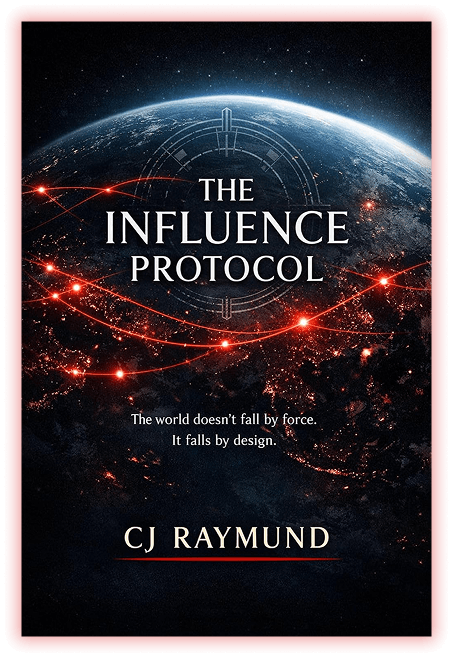
In The Influence Protocol, the story expands beyond engineered financial chaos and into the forces shaping governments, institutions, and the decisions made at the highest levels of power.
When a covert operation in Venezuela exposes connections between global markets, political instability, and strategic infrastructure, Cyrus Aragon and his team begin to uncover a pattern that is far more sophisticated than a conventional attack.
There is no army to find. No obvious enemy to stop. Instead, someone is manipulating the conditions under which powerful people make decisions.
The Influence Protocol is the second book of the highly anticipated Protocol Series, taking CJ Raymund’s exploration of hidden systems into the worlds of geopolitics, power, and influence.
For inquiries, collaborations, or speaking engagements, reach out directly to CJ at info@cjraymund.com



The compound had existed on satellite imagery for nearly eighteen
months before anyone decided to act. From orbit it appeared
insignificant—a scattering of concrete structures hidden beneath dense
vegetation several miles north of Lake Maracaibo. Dirt roads connected
the buildings beneath a canopy thick enough to frustrate casual
observation, while the surrounding terrain provided natural
concealment from anyone approaching on the ground. At first analysts
dismissed the location as another agricultural operation, one of
thousands scattered throughout western Venezuela. Only after months
of collection did the pattern begin to emerge. Trucks arrived at irregular
hours. Communications traffic surged unexpectedly. Armed personnel
appeared and disappeared. Deliveries entered the compound far more
frequently than anything operating in the region should have required.
Individually, the indicators meant little. Together, they painted a
different picture.
By the time intelligence agencies reached consensus, the assessment
was straightforward. The location had become a regional logistics hub
supporting cartel operations throughout northern South America.
Analysts believed narcotics moved through the facility before entering
established trafficking corridors. Signals intercepts suggested weapons
storage. Human intelligence sources reported armed security, restricted
access, and unusual activity surrounding several warehouse structures.
Drone surveillance identified vehicles associated with organizations
already under investigation.
The evidence was never perfect. Intelligence rarely was. But
eventually uncertainty became more expensive than action. At some
point, probability became sufficient, and an operation received
authorization. The raid began forty-three minutes before sunrise.
Darkness still covered the countryside when the helicopters crossed
the coastline and pushed inland at low altitude. Navigation lights
remained dark. Rotor wash flattened vegetation beneath them while
humid air rolled across open doors and into the aircraft. Inside the lead
helicopter, operators sat motionless beneath dim red lighting, faces
concealed behind helmets and communications equipment. Months of
planning had reduced the mission to a sequence of actions practiced so
many times that conversation had become unnecessary.
The objective appeared exactly where intelligence predicted.
Warehouse roofs emerged from darkness as the helicopters crossed a
low ridgeline. Thermal imaging immediately identified movement
within the compound. Armed personnel. Vehicles. Guard positions.
Everything matched the intelligence picture.
The assault force moved before anyone inside the compound fully
understood what was happening, the first explosions shattering the
quiet morning.
Security positions disappeared beneath controlled detonations.
Floodlights exploded. Communications antennas collapsed. Operators
breached the perimeter from multiple directions while aircraft overhead
monitored escape routes and relayed intelligence updates. Sporadic
gunfire echoed through the compound. Return fire followed. The
engagement was brief, violent, and surprisingly disorganized. Several
armed defenders attempted to establish positions before abandoning
them entirely. Others fled. A handful surrendered.
The resistance lasted less than fifteen minutes, far shorter than
planners had expected. By the time the first traces of dawn appeared
above the horizon, the compound belonged to them. What followed was
routine. Structures were secured. Buildings were cleared. Personnel
identified. Evidence documented. Assets inventoried.
The procedural rhythm of post-operation exploitation was familiar to
everyone involved. It had played out countless times across operations
around the world, and nobody expected surprises. The intelligence had
been remarkably consistent. Weapons. Drugs. Cash. Records. Perhaps a
senior cartel figure if fortune cooperated.
Instead, the first warehouse contained medicine.
Thousands of cartons occupied industrial shelving that stretched
nearly the length of the building. Antibiotics. Vaccines. Trauma kits.
Surgical supplies. Portable refrigeration units. Pallets wrapped in plastic
displayed humanitarian markings from organizations operating
throughout South America. Several cartons carried logos belonging to
nonprofit aid networks active in Venezuela and Colombia. Others
displayed labels associated with international relief programs funded in
part through grants originating from the United States.
For several moments, nobody said anything.
Operators moved slowly through the aisles studying shipment labels,
inventory manifests, and warehouse markings. Everything appeared
orderly. Everything appeared documented. Everything appeared
legitimate.
The second warehouse produced similar results. Food supplies. Water
purification systems. Emergency shelter materials. Medical equipment.
The third warehouse revealed additional inventories supporting
regional aid operations. Nothing resembled a cartel operation. Again,
everything appeared legitimate. Again, everything was documented.
Again, everything was exactly where it should have been.
An uncomfortable possibility spread quietly through the compound.
What if the intelligence had been wrong? No one voiced the question, but
everyone felt it. Months of surveillance. Satellite imagery. Intercepted
communications. Human sources. Operational planning. International
coordination. Beneath fluorescent lights illuminating pallets of
medicine and emergency supplies, all of it suddenly felt less certain.
One supervisor reviewed the intelligence package again while
another examined shipment manifests recovered from the
administrative office. The paperwork matched the inventory. The
inventory matched the labels. The labels matched the shipping records.
Nothing looked criminal. Nothing resembled a cartel logistics hub.
The atmosphere shifted. Not toward relief. Toward concern.
Nobody wanted to be responsible for explaining why an international
operation had just raided what increasingly resembled a humanitarian
distribution center.
The doubt lingered until Sergeant Javier Morales stopped beside a
pallet near the rear of the first warehouse.
The cartons were labeled as emergency trauma kits destined for rural
medical clinics throughout western Venezuela. Morales glanced at the
shipping label before reaching down to move one of the boxes.
The carton barely budged.
Morales frowned. Most people would have thought nothing of it.
Years of moving cargo had taught him exactly how a thirty-pound
medical supply carton should feel. This wasn’t it.
He tried again, dragging the box several inches across the pallet. The
effort required was unmistakable.
Morales crouched beside the carton and studied the shipping
documentation attached to its side.
Emergency Trauma Kits
Quantity: 24
Net Weight: 31 lbs
Morales looked from the label to the box, then back to the label.
“Something’s wrong.”
The comment drew little attention. By that point dozens of personnel
were cataloging inventory throughout the facility.
Morales knelt beside the carton and pulled a utility knife from his
vest. The blade sliced easily through packing tape. Inside he found
exactly what the label claimed.
Bandages.
Gauze.
Medical dressings.
Trauma supplies.
For a brief moment, Morales wondered whether fatigue had misled
him. Then he removed the contents and lifted the carton again. It was
still far too heavy. His expression hardened.
A second cut exposed a reinforced interior panel concealed beneath
the legitimate supplies. The compartment had been professionally
constructed, hidden so cleanly it would escape casual inspection
entirely.
Morales drove the blade deeper until the false bottom gave way.
Silence settled around him.
Inside the compartment sat tightly wrapped bundles sealed in
waterproof packaging. Every experienced operator in the building
recognized them immediately.
Within minutes, additional crates were opened throughout the
warehouse, and the pattern repeated everywhere. Medicine concealed
narcotics. Food shipments concealed currency. Water filtration
equipment concealed weapons components. Emergency shelter
materials concealed fraudulent identification documents and encrypted
communications equipment.
The humanitarian supplies were genuine. The contraband was
genuine. Neither existed to disguise the other. They had been integrated
into the same logistics system, moving together through the same
network without attracting attention.
The warehouse suddenly looked different.
Then investigators reached the administrative offices.
At first the records appeared as ordinary as everything else in the
facility. Shipping manifests. Customs documentation. Inventory
records. Funding reports. The paperwork expected inside any
distribution center supporting humanitarian operations across
multiple countries.
Analysts began sorting through the material. What they found raised
even more questions. The shipments did not originate from a single
organization. One manifest referenced a medical aid network operating
in Venezuela. Another identified water purification equipment supplied
through a regional relief initiative in Colombia. Additional records
linked food assistance shipments to organizations operating in Ecuador,
Peru, and northern Brazil.
Nothing pointed to a common supplier.
Different organizations. Different countries. Different supply chains.
Yet everything converged on the same destination. The same
compound. The same cartel-controlled logistics network.
As the morning progressed, inventory teams continued documenting
evidence while intelligence officers transmitted preliminary findings
through secure channels. Photographs arrived first. Then manifests.
Then shipment records. Then funding documentation. Analysts
reviewing the material quickly identified references to multiple aid
programs, international donors, government grants, and nonprofit
organizations operating throughout the region.
The implications spread almost immediately. A single compromised
shipment could be explained. A corrupt driver. A stolen container. A
warehouse manager accepting payment from the wrong people. Three
organizations suggested something larger. Five revealed a pattern.
The records recovered from the compound suggested shipments had
moved through distribution centers across multiple countries over
several years. Some manifests referenced routes investigators had never
previously associated with cartel activity. Others identified
organizations with long-established reputations and extensive
humanitarian operations.
Questions multiplied faster than answers.
How long had the network existed?
How many organizations had been compromised?
Were aid workers involved?
Were executives aware?
Had the cartels infiltrated humanitarian programs?
Or had they simply exploited vulnerabilities nobody realized existed?
No one yet possessed enough information to know how deeply the
network extended. What everyone did understand was far simpler. The
cartel had benefited. That much was beyond dispute.
Had investigators uncovered an isolated operation hidden within a handful
of supply chains?
Or had they stumbled across the first visible piece of something far larger?
The rising Venezuelan sun spilled through the warehouse doors and
illuminated rows of medicine, vaccines, food, radios, weapons,
narcotics, and cash stacked side by side on industrial shelving.
The evidence was undeniable.
The scope was not.