
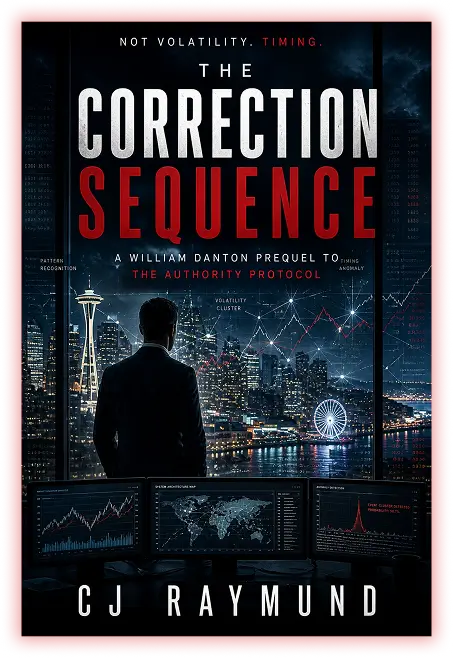
William Danton built his career on staying rational and keeping his head down. Then he found something that he shouldn’t have.
What begins as a quiet inconsistency buried inside financial movement becomes impossible to ignore, forcing William to question whether instability is really accidental or actually carefully designed.
As he follows the signal deeper, he finds himself approaching a truth that was never meant to be discovered.
The Correction Sequence is the prequel to The Authority Protocol, a tense, intelligent thriller about the moment observation becomes suspicion, and suspicion becomes something far more dangerous.
For inquiries, collaborations, or speaking engagements, reach out directly to CJ at info@cjraymund.com



The drop didn’t look unusual at first, arriving in the middle of the day between routine movement and the kind of noise most traders filtered out without thinking. The headline that triggered it carried just enough weight to introduce uncertainty without defining it—a revision to earnings, a shift in guidance, language that lived in the space between concern and overreaction. The kind of update that rarely held attention for long.
That was enough.
The price slipped, then moved lower, the initial reaction unfolding within expectation as volume increased and positions unwound in sequence. Orders triggered as they always did when uncertainty entered the system, screens updating without pause as red gradually replaced green in a progression that felt familiar, structured, and easy to dismiss as part of a cycle the market had repeated countless times before.
Then it accelerated.
Not dramatically and not all at once, but enough to pull attention. Enough to create pressure. The decline sharpened as it moved, each level breaking with less resistance than it should have, the selling feeding into itself without interruption in a rhythm that felt slightly ahead of where it ought to have been.
From the outside, it made sense. A weaker outlook. A predictable market reaction. Nothing that required attention, which was precisely why nobody questioned it.
The fall didn’t break. It stopped.
Not gradually, and not because momentum faded or cautious buyers stepped in to test the floor. It simply held at a level that felt strangely deliberate, close enough to the bottom to matter and far enough from the top to remain believable. For a moment, nothing moved. The pressure remained, but the decline no longer seemed interested in continuing.
Nothing about the correction was impossible.
That was what made it dangerous.
And that was when something shifted—not in direction, but in behavior.
The first entries appeared near the bottom, small enough to avoid notice and timed just after the decline stabilized. They arrived without urgency, measured and disciplined, blending into the existing movement so naturally that most observers would never have recognized them for what they were. Then more followed. Not clustered. Not aggressive. Just present.
The price responded—not with volatility, but with direction.
Gradually at first, then with growing confidence, the same levels that had broken on the way down began reestablishing themselves. Resistance became support. Volume returned, not as panic but as participation. By then the shift had already occurred.
By late afternoon, the narrative had begun rewriting the event. Analysts framed the movement as an overreaction. Commentators pointed to resilience, underlying strength, and stability that had not existed long enough to be proven. Explanations spread faster than questions, and by the time most observers arrived at a conclusion, the conclusion had already been provided for them.
The recovery held.
It always seemed to.
By the closing bell, the decline had been reduced to something manageable, controlled enough to avoid scrutiny and familiar enough to be forgotten. From the outside, it was a correction. Inside the movement, it followed a pattern.
Decline.
Stabilization.
Recovery.
The sequence was familiar.
The precision inside was not.
At the lowest point of the day, where uncertainty still carried weight and risk still felt real, a series of order executed with a precision that required neither visibility nor attention. Positions entered, held, and exited quietly, completely, as if they had always been part of the movement.
The closing bell rang.
No interruption.
No disruption.
The market moved on, and the sequence disappeared into millions of transactions that would be archived, reviewed, and ultimately dismissed as evidence of a system functioning exactly as intended.
Unless—
you knew where to look.
Excerpt From
The Correction Sequence
CJ Raymund
This material may be protected by copyright.